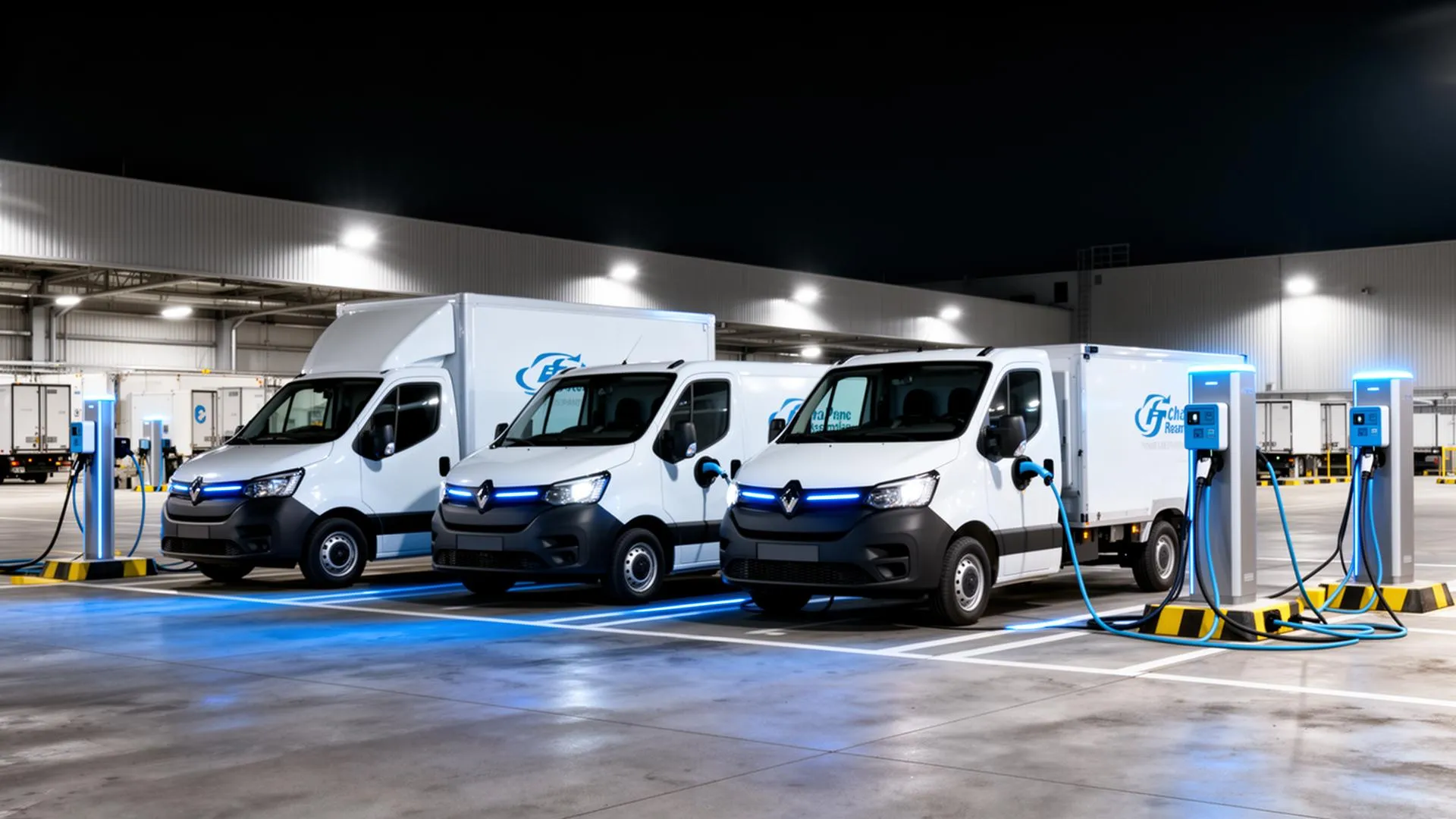
EcoDrive is being developed to estimate the energy a planned electric-van mission may require. Bring route, vehicle, payload and operating assumptions together before the vehicle leaves the depot.
Representative electric fleet depot · image source: Pleevi
Mission assessmentSIMULATED
Manchester → Leeds
Example route · representative inputs only
69 kmPlanned distance
— kWhEnergy estimate
Illustrative interface — no live fleet telemetry
The operational challenge
A route is not the whole energy story.
Quoted range is a useful reference, but a real mission also depends on the vehicle configuration, payload, speed, elevation, temperature and auxiliary demand. Those conditions need to be considered together.
◌
Temperature
Ambient conditions and battery thermal state can affect usable energy and vehicle efficiency. The estimate should make its assumptions visible.
▤
Payload
The mass carried by a delivery van changes the energy needed to accelerate, climb and overcome rolling resistance.
⌁
Route profile
Distance alone does not describe elevation changes, driving speed or stop-start operation across a planned route.
⌁
Auxiliary demand
Cabin heating, cooling and other electrical loads draw energy during the mission and can matter on longer or colder journeys.
The operational setting: commercial vehicles, real routes, daily delivery commitments.
The question before departure
Will the planned mission leave enough energy margin?
That is the question PulseMotion is designed to help a dispatcher examine before a vehicle goes out. The goal is not to replace the operator's judgement; it is to make the assumptions and estimated energy picture easier to review.
01Describe the mission and vehicle configuration.
02Estimate energy demand from the available inputs.
03Review the reserve estimate, key drivers and limitations.
The PulseMotion approach
From mission inputs to a decision-support view.
EcoDrive brings together physical energy factors to produce a pre-dispatch estimate. SECU is an advisory layer intended to surface recommendations when the estimated reserve looks tight. Dispatch remains a human decision.
01 / DEFINE
Mission and vehicle
Set the planned route, vehicle configuration, starting state of charge, payload and relevant operating conditions.
02 / ESTIMATE
EcoDrive model
Estimate mission energy using road-load and auxiliary-load components, while making important assumptions and data gaps clear.
03 / REVIEW
Reserve and risk
Review estimated remaining energy and the factors most likely to influence the result before dispatch.
04 / LEARN
Compare with outcomes
A future validation workflow will compare estimates with recorded mission energy to assess error and identify where calibration is needed.
Two distinct responsibilities
Estimate first. Recommend second.
◈
EcoDrive
PHYSICS-BASED ENERGY ESTIMATION
EcoDrive is the mission energy-estimation component. It is designed to combine vehicle and route inputs with relevant physical contributors instead of relying on a single advertised range number.
↔
Rolling resistance
Accounts for energy associated with tyres and vehicle mass.
≈
Aerodynamic drag
Considers the effect of air resistance and speed assumptions.
⌁
Elevation and motion
Route grade and driving profile matter; missing route detail should be treated as uncertainty, not invented precision.
◌
Battery and auxiliary demand
Accounts for stated battery capacity, temperature-related assumptions and electrical loads where supported by inputs.
Designed output
GOMARGINALHIGH RISKABORT
Decision categories are model outputs for review, not a guarantee of real-world mission outcome.
⚙
SECU
SMART ENERGY CONTROL UNIT · ADVISORY LAYER
SECU is intended to translate the estimated energy picture into practical prompts. It is advisory: it does not directly control a vehicle or make a dispatch decision.
Low estimated reserve
Review auxiliary-load assumptions and reduction options.
High-risk estimate
Flag the mission for dispatcher review.
Insufficient input data
Show limitations rather than imply certainty.
Before dispatch
Keep the operator responsible for the final decision.
Current design principle: human-in-the-loop
Recommendations are reviewed by an operator. Autonomous vehicle commands are not presented as a current capability.
Decision ownership
The dispatcher remains responsible for whether and how to proceed.
The interface below is a design illustration of the information a dispatcher needs to review. It is not a live mission result and does not display live vehicle telemetry.
Designed for pre-dispatch review
1
Start with the missionEnter the planned route, selected vehicle, payload and starting battery state.
2
Understand what drives demandReview the main energy contributors and identify missing or uncertain inputs.
3
Keep a human in the loopUse the estimate as decision support, not as a substitute for operational judgement.
EcoDrive / Mission review
PRE-DISPATCH PLANNING WORKSPACE
UI CONCEPT
Mission inputs
RouteManchester → Leeds
Distance69 km
VehicleExample van
PayloadNot specified
TemperatureInput required
Assessment
—Energy (kWh)
—Reserve
—Risk class
ⓘEstimate not shown. This concept panel intentionally avoids inventing a prediction. A result depends on model execution and valid mission inputs.
What the dispatcher should see
Estimated energy demand and remaining reserveModel output
Key assumptions and missing inputsVisible
Recommendation and reasonOperator review
ILLUSTRATIVE INTERFACENO LIVE TELEMETRY
Validation before claims
Built to be tested against real missions.
The next important milestone is not another feature. It is a structured comparison between pre-dispatch estimates and recorded energy use from real electric-van missions.
⌘
What exists
A browser-based planning interface and physics-model prototype.
Representative vehicle profiles and simulated mission scenarios.
An advisory decision-support concept for dispatcher review.
▤
What needs validation
Prediction error against actual mission energy.
Performance across vehicle variants, payloads and conditions.
Whether recommendations improve decisions in fleet operations.
↗
What a pilot would measure
Predicted versus recorded energy consumption.
Error distribution and systematic model drift.
Dispatcher usefulness, data quality and practical limitations.
Current status: PulseMotion is an early-stage product. Simulated scenarios are not real-world validation. We do not yet claim proven prediction accuracy from live fleet data, signed fleet pilots, or autonomous vehicle control. Pilot discussions are intended to help establish the evidence needed for those claims.
PulseMotion / UK Pilot Programme
Discuss a validation pilot
We're looking to speak with UK fleet operators about a structured validation pilot. Scope, data requirements and terms would be agreed with each prospective partner.
Planning workspace
Planning tools
Insights
⬡
Sample missions·Representative missions, energy estimates and advisory recommendations
👋
First time here? Here's where to start.
① Mission Control→② Run a Prediction→③ Fleet Command→④ ESG Report
No mission data yet. Load representative sample data to explore the planning interface.
SECUACTIVE
Monitored124
Prevented11
Energy Saved420 kWh
Fleet Reserve+450 kWh
Grid Price£0.29/kWh
Grid Supply7,400 kWh
Grid Demand6,950 kWh
SECU MODE
System Time--:--:--
💡Sample missions uses representative UK vehicle profiles to demonstrate the planning model. Load demo data to explore the interface; it is not live fleet telemetry.
PulseMotion / Sample missions
Representative Fleet View
Example energy estimates and advisory recommendations
Fleet Energy Balance
Available
—
Required
—
Balance
—
At-Risk Vehicles
—
Required—
Loading…
Active Missions
12 active
Sample Fleet Map — United Kingdom
● Safe ● Warning ● Risk
Select a sample mission to view its estimate
SECU Decision Engine
0 actions
Analysing fleet energy state…
System Event Log
Live
💡Fleet Command is your pre-dispatch readiness dashboard. It shows whether each vehicle is safe to dispatch today. Expand any vehicle row to see the full energy breakdown behind its dispatch decision.
PulseMotion / Fleet Command
Prevent EV Fleet Mission Failure Before Dispatch
Energy planning for UK electric vehicle fleets
Fleet Risk Score — Today
—
Calculating a model-derived risk score…
12
Missions Today
—
Cleared
—
Marginal
—
At Risk
EcoDrive Status
● Local model loaded
EcoDrive v4.0 · pre-calibration prototype
Scenario estimate · assumptions shown below
Total Fleet Vehicles
12
Active in registry
Cleared for Dispatch
—
Energy score ≥ 70
Vehicles At Risk
—
Require operator review
Demo missions flagged for review
—
Simulated sample view · not a 24-hour forecast
Readiness chart — awaiting observed data
No historical fleet observations are available; no readiness trend is displayed.
No observed daily fleet-readiness data is available yet. Sample/demo values are intentionally not plotted as operational history.
Energy model components
Modelled terms only · contribution shares depend on mission inputs
Traction and auxiliary energy demandEstimated from model inputs
Potential regenerative recoveryEstimated where the selected inputs support it
Model scope: The estimate accounts for modelled traction demand, auxiliary demand and potential regenerative recovery where supported by the selected inputs. This panel does not represent measured energy shares or verified savings.
Sample mission assessments
Illustrative outputs from simulated fleet profiles — not live telemetry; click any row to inspect the sample
Vehicle ID
Mission Route
Distance
Payload
Battery SoC
Energy Score
Reserve
Status
Vehicle Energy Diagnostics
🔍
Select a vehicle above to view full energy diagnostics and dispatch recommendation.
Sample missions flagged for operator review
Rule-based demo categorisation · not a 24-hour forecast
Vehicle
Risk
Primary Cause
Action
Sample Fleet Energy Map — United Kingdom
● Safe Route● Marginal● High Risk
Vehicle Profile Registry
Reference specifications and user-entered attributes; battery health is not a calibrated degradation forecast
💡Mission analysis is where EcoDrive runs. Enter a vehicle and planned mission details, then select Run EcoDrive Analysis to review the estimated energy use, reserve and recommendation.
PulseMotion / Mission analysis
EcoDrive Prediction Engine
Know if a mission will succeed before the vehicle leaves the depot
Mission Parameters
🏔️Fetching real elevation data...
💨Fetching live wind data...
⚠️ Cold chain / refrigerated vehicle detected. SECU will not throttle HVAC or auxiliary temperature systems on this vehicle. Energy interventions limited to regen maximisation and non-critical auxiliary reduction only.
Run a mission analysis to view relevant SECU recommendations.
Energy Budget Breakdown
📊
Run a mission to see real-time energy budget allocation across rolling resistance, drag, grade, and HVAC.
SECU Architecture
Input: EcoDrive result · predicted_reserve · soc · terrain ↓ Rule Engine: priority-ordered evaluation ↓ Output: recommendations[] · risk_level ↓ Dispatcher: reviews and approves each action ↓ Dispatch: GO | MARGINAL | HIGH | ABORT
Current prototype: Advisory recommendations only — the human dispatcher retains control. Future work: Vehicle-system integration is not implemented and would require separate safety, OEM and operator review.
💡Risk & Anomaly lets you compare estimated and recorded energy use after a mission. Record likely contributors such as payload, temperature or auxiliary load.
PulseMotion / Risk & Anomaly Detection
Failure Classification Engine
Compare predicted vs actual energy. Classify root cause. Build the mission registry dataset.
Post-Mission Analysis
Predicted (EcoDrive)
Actual (Post-Mission Telemetry)
Classification Result
🔬
Enter predicted and actual values then run the classifier to attribute variance to its root cause.
No anomalies classified yet. Load demo data or simulate 50 missions from the Reports page.
💡Analytics shows fleet-level trends across all your missions. Hit Simulate 50 Missions on the Reports page to instantly populate all charts with realistic UK fleet data — then come back here to explore.
PulseMotion / Analytics
Fleet Analytics
Mission, vehicle and energy summaries
Sample risk-category summary
—
Simulate missions or run EcoDrive analyses to generate forecast
Payload Variance—
Thermal Loss (Cold Weather)—
Auxiliary Drain—
Fleet Reliability
—
Mission success rate
Abort Rate
—
Flagged missions
Missions Run
0
This session
Avg Variance
—
Predicted vs actual
Recent Missions
Vehicle
Distance
Energy Used
Risk Score
Dispatch
⚡
No missions yet. Run your first EcoDrive analysis.
Anomaly Distribution
🔬
Classify failures on the Risk & Anomaly page to see cause distribution.
Risk Score History
No mission history yet.
SECU Intervention Log
No interventions logged.
💡Reports generates a prototype summary from modelled/sample records. Simulated records are not evidence of actual fleet performance and must not be submitted as metered compliance data.
PulseMotion / Reports
Mission Energy Fleet Report
Prototype export of modelled mission estimates. Not metered energy data and not a verified SECR compliance report.
Fleet Reliability Score
—
Reliability
Fleet Summary
Total Missions—
Successful Completions—
Aborted / High Risk—
Avg Energy Consumption—
SECU Interventions—
Top Anomaly Causes
Hit Simulate 50 Missions or ⚡ Demo Mode to instantly generate a full dataset.
Energy Variance Report
No variance data yet.
Mission Audit Log
No missions recorded.
Platform Development Status
Prototype capability status · updated October 2026; statuses describe code/UI presence, not field validation
Feature
Status
Notes
EcoDrive v4.0 Physics Engine
In prototype
Rolling resistance, aero drag, grade energy, thermal capacity correction, regen braking — present in the prototype; not field-validated
SECU Advisory Layer v1.0
In prototype
Rules-based advisory concepts; dispatch decisions remain with the operator. Rule count and thresholds require code/UI reconciliation.
Weather API Integration
In prototype
Weather lookup code is present; API availability, route matching and returned values must be checked during each session.
Elevation API Integration
In prototype
Elevation data may be requested when available; route/elevation coverage and accuracy require verification for each mission.
Battery health / degradation adjustment
Not calibrated
Not used as a validated degradation curve in this build. Do not interpret placeholder health fields as a measured battery-health model.
Modelled energy / carbon export prototype
In prototype
Prototype export functionality only. Modelled energy is not metered energy; this is not a verified SECR compliance report.
Supabase Mission Persistence
In prototype
Persistence code is present. Verify Supabase Row Level Security and test access controls before any real data is stored.
Driver Behaviour Coefficient
🔄 In Development
Scenario multipliers are model assumptions; no driver-specific historical calibration has been demonstrated.
Dynamic Risk Thresholds
🔄 In Development
Fleet-type-specific thresholds — requires 50+ mission baseline for calibration
OBD2 / Telematics Ingestion
🎯 Phase 2
Real vehicle data pipeline — replaces operator-entered parameters with live telemetry
OEM API Integration
🎯 Phase 2
Not implemented. Any future vehicle-control capability would require separate safety, OEM, operator and regulatory review.
Future research concept — not available
Future concept
Not part of the current product. No autonomous dispatch or vehicle control is available.
Proposed Validation Pilot
Proposed 60–90 day study · scope and terms to be agreed · success criteria pre-registered with the operator
60–90
Days
50+
Missions Required
Pilot target
Proposed error threshold
Free
For Pilot Partners
Objective
Measure EcoDrive prediction accuracy against actual vehicle energy consumption across real UK fleet missions.
Hypothesis
Pilot hypothesis only: compare EcoDrive estimates with a defined OEM-range baseline using the same missions and measured outcomes. No superiority has been demonstrated.
Success Metric
Proposed evaluation target, not current performance: assess prediction error over a pre-agreed sample of missions with measured energy data. Current uncertainty is not established by field data.
Permission to use anonymised data in model training
Post-pilot agreement: Continued access offered if success metrics are met. No obligation, no sales pressure, no upfront cost. We are looking for fleet operators who want accurate energy prediction and are willing to share charge log data to prove it works.